by
by Rising majestically above central Switzerland, Mount Rigi has long fascinated travelers, scientists, and nature enthusiasts. Often called the “Queen of the Mountains,” Rigi offers panoramic views of the surrounding landscapes, including Lake Lucerne and Lake Zug. While the mountain is famous for its scenic hiking trails and historic railways, another phenomenon has quietly intrigued observers for centuries: the unique thermal layers that form around its slopes.
These thermal layers influence weather patterns, create distinctive cloud formations, and contribute to the mountain’s famous sunrises and sunsets. Understanding the science behind them reveals how geography, atmospheric physics, and local climate interact in remarkable ways. This article explores how thermal layers form around Mount Rigi, why they are so noticeable in this region, and what they mean for visitors, meteorologists, and environmental researchers.
What Are Thermal Layers?
Thermal layers occur when air masses with different temperatures stack on top of one another in the atmosphere. Under normal conditions, air temperature decreases as altitude increases. However, certain conditions can cause temperature inversions, where warmer air sits above cooler air.
This layered structure creates a stable atmospheric environment where air mixing is limited. As a result, clouds, fog, and pollutants may become trapped within specific altitude ranges.
Mountains like Mount Rigi provide an ideal setting for observing these phenomena because elevation changes allow scientists and visitors to experience multiple atmospheric layers within a relatively short vertical distance.
The Geography That Makes Rigi Unique
The geographic position of Mount Rigi plays a key role in the formation of its thermal layers. Located between two large bodies of water—Lake Lucerne and Lake Zug—the mountain sits in a region where air circulation patterns are strongly influenced by lakes and surrounding valleys.
Compared to land, water bodies heat and cool more slowly. During the night, the air above the lakes remains relatively mild, while cooler air sinks into nearby valleys. This contrast helps create temperature differences that lead to layered atmospheric conditions.
Additionally, the surrounding topography funnels wind through valleys, helping maintain these temperature contrasts for extended periods.
How Temperature Inversions Form
One of the most visible aspects of Rigi’s thermal layers is the temperature inversion, a phenomenon that reverses the typical atmospheric temperature pattern.
Here’s how it generally develops:
- Nighttime Cooling – After sunset, the ground rapidly loses heat through radiation.
- Cold Air Accumulation – Cooler, denser air sinks into valleys around the mountain.
- Warmer Air Above – Higher elevations remain relatively warmer because they are less affected by ground cooling.
- Layer Formation – A stable boundary forms between the cold valley air and the warmer air above it.
This layered structure can persist for hours or even days, especially during calm winter weather.
When this happens near Mount Rigi, hikers on the summit may stand in bright sunshine while thick fog blankets the valleys below.
The Role of Lakes in Thermal Layer Formation
The lakes surrounding the mountain play an important role in shaping its atmospheric conditions. Lake Lucerne, with its large surface area and irregular shape, stores heat during warmer months and releases it slowly at night.
This gradual heat release warms the air above the water and influences nearby air circulation patterns.
Similarly, Lake Zug contributes additional moisture and thermal stability to the region’s atmosphere. The combined effect of these lakes often strengthens temperature inversions, making the thermal layers around Mount Rigi particularly pronounced.
Seasonal Variations in Thermal Layers
Although thermal layers can occur at any time of year, they are most noticeable during autumn and winter.
Winter Conditions
Cold, calm winter nights are ideal for inversion formation. Snow-covered landscapes reflect sunlight and maintain cooler surface temperatures, reinforcing the contrast between valley air and higher elevations.
During winter mornings, the summit of Mount Rigi may enjoy clear skies while the surrounding valleys remain hidden beneath a thick layer of fog.
Summer Conditions
In summer, stronger solar heating usually breaks up inversions more quickly. However, early morning inversions can still occur, especially after clear nights.
These brief thermal layers often dissolve shortly after sunrise as the sun warms the ground and triggers atmospheric mixing.
Fog Seas and Cloud Layers
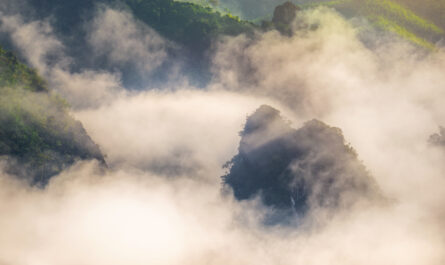
One of the most visually striking results of Rigi’s thermal layers is the formation of a “fog sea.” This occurs when the cold air trapped in valleys becomes saturated with moisture, forming a dense layer of fog.
From higher elevations on Mount Rigi, the fog appears like an endless white ocean stretching across the landscape.
Peaks and ridges rise above this cloud layer like islands, creating a dramatic contrast between sunlight above and mist below. Photographers and travelers often visit the mountain specifically to witness this phenomenon.
Impact on Local Weather Patterns
Thermal layers influence weather in several ways. Because temperature inversions limit vertical air movement, they can trap moisture and pollutants in lower atmospheric layers.
In cities and valleys, this may lead to persistent fog or haze.
However, higher elevations like Mount Rigi experience clearer skies during these conditions. This difference explains why mountain viewpoints are often sunny while surrounding lowlands remain overcast.
Meteorologists study these patterns to better understand regional weather behavior.
Benefits for Tourism and Outdoor Activities
The thermal layers around Mount Rigi create unique experiences for visitors.
Hikers, photographers, and nature lovers frequently seek out the mountain during inversion events to enjoy spectacular views above the fog.
The phenomenon also contributes to the region’s reputation for extraordinary sunrises. As sunlight spreads across the fog layer, it produces glowing colors and dramatic lighting effects.
Many travelers plan early-morning visits to witness these unforgettable scenes.
Scientific Research and Observation
Mount Rigi has long served as an informal observation site for atmospheric science. Its accessibility and moderate elevation make it ideal for studying temperature inversions and mountain weather patterns.
Researchers monitor temperature gradients, humidity levels, and wind movement to understand how atmospheric layers develop and change.
Data collected in alpine environments contributes to broader studies in meteorology, climate science, and environmental monitoring.
Environmental Implications
Thermal layers also have environmental consequences. When pollutants become trapped beneath inversion layers, air quality in valleys can temporarily decline.
Understanding these patterns helps authorities manage environmental challenges and predict pollution events.
At the same time, studying thermal layers offers valuable insights into how climate change might affect alpine weather systems.
Scientists continue to analyze long-term data to determine whether warming temperatures are altering inversion frequency and strength.
Experiencing the Thermal Layers Firsthand
Visitors who want to observe Rigi’s famous thermal layers can improve their chances by planning trips during stable high-pressure weather conditions.
Clear nights followed by calm mornings often produce the best inversion events. Early sunrise hikes provide an especially rewarding opportunity to witness the fog sea and layered atmosphere.
Watching the sun gradually illuminate the surrounding peaks while clouds linger below is an experience that perfectly captures the magic of alpine landscapes.
Conclusion
The famous thermal layers of Mount Rigi are the result of a complex interaction between geography, climate, and atmospheric physics. Positioned between Lake Lucerne and Lake Zug, the mountain sits in a region where temperature contrasts and air circulation patterns naturally create layered atmospheric conditions.
From dramatic fog seas to clear skies above the clouds, these thermal layers contribute to some of the most memorable landscapes in Switzerland. They also provide valuable insights into how mountains influence weather and environmental processes.
For travelers, scientists, and nature enthusiasts alike, Mount Rigi’s atmospheric layers offer a fascinating reminder that the beauty of the mountains extends far beyond what we see on the surface.